Three rummy formats, three different tables
The Indian rummy market is dominated by three formats. Points Rummy is a single deal with a per-point rupee value. Deals Rummy runs three pre-set deals against a chip stack. Pool Rummy continues until a seat crosses an elimination threshold. The Games hub walks through each one with the published rules, the standard drop penalties and the scoring math the editor sits behind.
Points Rummy, Deals Rummy and Pool Rummy in the Indian market
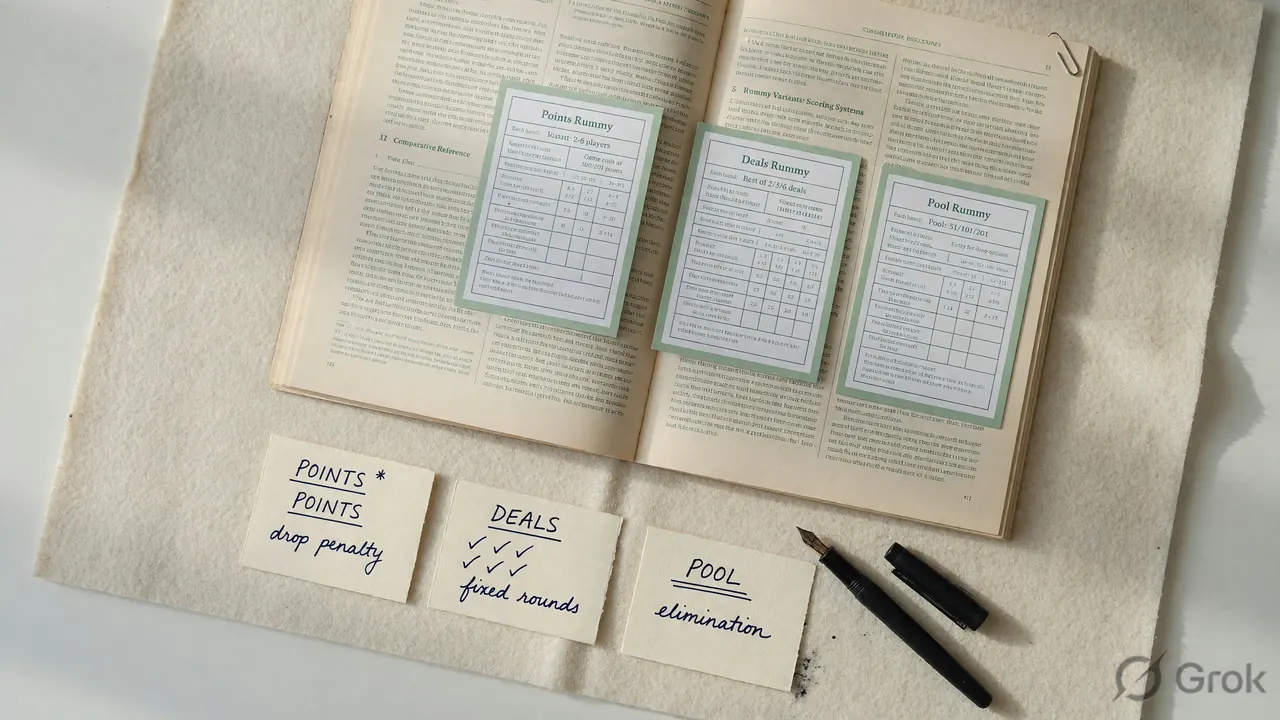
The Indian rummy market runs on three published formats. Each format has a fixed rules table, a fixed drop ladder, and a fixed scoring math. The Games hub walks through all three so the reader can see the structural difference between a one-deal table, a three-deal chip stack, and an elimination pool before sitting down at any one of them.
Points Rummy is the most common table at the lower stake band. A single deal is dealt, each player carries a fixed rupee value per point, the table rate is set at the start of the deal, and the winner collects the deadwood of every other seat at that table rate. The published drop ladder is 25 for a first-life drop, 50 for a middle drop, and 80 for a full-count drop on the standard 80-point table. The horizon is one deal.
Deals Rummy is the format that rewards consistency across a fixed horizon. Three pre-set deals are dealt back-to-back against a chip stack. Each seat begins with the same chip value, and the seat with the highest cumulative score after the third deal wins the pool. There is no mid-game re-buy. A bad first deal can still be recovered from if the second and third deals are strong.
Pool Rummy is the format that rewards patience. The standard 101-pool continues until one seat crosses the 101-point threshold and is eliminated. The 201-pool runs a longer horizon. The drop ladder is mid-life, not full-count: a first-life drop costs 25, a middle drop costs 50, and the eliminated seat is out of the pool. The last seat alive takes the pool.
The structural difference, in one paragraph, is the horizon. Points Rummy has the shortest horizon and the simplest resolution. Deals Rummy has a fixed horizon of three deals and rewards cumulative score. Pool Rummy has no horizon short of elimination and rewards drop discipline and an exit threshold chosen before the first hand.
Card values and the deal-discard cycle
The 13-card table is the standard Indian rummy deal. Each seat receives 13 cards face-down, two closed decks are placed in the centre, and an open discard pile is turned up from one of those closed decks. The player to the dealer’s left begins the draw, and play continues clockwise.
Card values follow the published table. Number cards (2 through 10) carry face value. The jack, queen and king each carry 10 points. The ace carries 1 point or 10 points depending on the meld it joins; the desk has not seen a published flow that scores the ace at any other value. The printed joker carries the value of the card it substitutes for in a meld, and zero in a sequence when used as a wild without a base card.
A pure sequence is three or more suited cards in consecutive rank with no joker. A second sequence may use a joker. A set is three or four cards of the same rank in different suits. The declaration is valid only when the seat has at least one pure sequence and the entire 13 cards resolve into valid sequences or sets. The printed joker, the wild joker and the declared suit joker are interchangeable as substitutes once a base card is named.
The draw is taken from the closed deck or the open discard pile. The discard is one card placed face-up on the open pile, except for the final discard which is the declaration. The desk flags the show as the moment the seat places the 14th card (the declaration) face-down on the table and announces a valid show.
The wild joker is turned up from the closed deck at the start of the deal. The wild joker is the card immediately below the closed-deck’s top card in rank; if the top card is a printed joker, the next card below is the wild joker. The declared suit joker is the printed joker in the suit of the wild joker; the printed joker and the wild joker and the declared suit joker are interchangeable as substitutes once a base card is named.
A pure sequence with a printed joker is not a pure sequence. A pure sequence with a wild joker is not a pure sequence. A pure sequence with a declared suit joker is not a pure sequence. A pure sequence must be suited and consecutive without any substitute. The desk has read this rule on every published rules table the desk has verified; the reader verifies the operator’s own page before applying the rule to a non-standard table.
How to read the format split
A player who treats Points as Pool endgames will over-drop in Points and under-drop in Pool. The drop math at a Points table is bounded by the table rate and the deadwood; the drop math at a Pool table is bounded by the elimination threshold and the remaining-life average. The deadwood ceiling is the same in both formats on the standard 80-point table, but the consequence of crossing the ceiling is materially different: a first-life drop at 25 on Points is a chip-saving move; a first-life drop at 25 on Pool is the same chip-saving move but with the additional consideration of the remaining-life average and the exit threshold.
A player who treats Deals as three independent Points deals will misread the chip stack. The cumulative score across the three deals is what matters, not the per-deal score. A strong second and third deal can pull a seat back into the pool even after a poor first deal. The desk has read published research that shows a seat that treats Deals as three independent deals over-drops on the first deal and under-drops on the third deal, materially lowering the seat’s chip stack on average.
A player who treats Pool as a long-form Points table will under-set the exit threshold. The exit threshold is the chip value at which the seat drops regardless of the hand; the threshold is set before the first hand. A seat that does not set the exit threshold is exposed to the full elimination threshold. The desk flags the unset-threshold pattern as a behavioural marker; the published research on pool endgame consistently shows that a seat with an unset threshold is materially more likely to be eliminated than a seat with a set threshold.
The hub pages do not recommend a platform. They walk through the published rules of each format and flag the boundaries the editor sees between legal play and probabilistic outcome. The strategy desk expands the drop math, the deadwood math and the pool endgame in separate chapters. The format-by-format split is also reflected in the comparison ledger, where each operator’s published table rate, drop ladder and pool threshold are recorded side-by-side for the reader’s own comparison.
The 21-card table is a parallel format the desk has read on a small set of operators. The 21-card table uses a 21-card hand instead of the standard 13-card hand, with a different meld grouping and a different show validity. The desk has read published rules tables for 21-card play; the rules are operator-specific and the reader verifies the operator’s own page before applying any of the math in the editorial chapter to a 21-card table.
Operational reference for the format split
A first-life drop at 25 is the desk’s published baseline for any Indian rummy format. The desk has read 25 as the first-life drop on every published rules table the desk has verified. A first-life drop is taken before the seat’s third turn; the seat pays 25 points on the standard 80-point table and exits the current deal. The first-life drop is the seat’s protection against an unplayable hand.
A middle drop at 50 is the desk’s published baseline for the middle drop. The desk has read 50 as the middle drop on every published rules table the desk has verified. A middle drop is taken after the seat’s third turn; the seat pays 50 points and exits the current deal. The middle drop is the seat’s protection against a structural problem that cannot be resolved in the remaining turns.
A full-count drop at 80 is the desk’s published baseline for the full-count drop. The desk has read 80 as the full-count drop on every published rules table the desk has verified on the standard 80-point table. A full-count drop is a 13-card ungrouped hand at show; the seat pays the maximum penalty and the deal is reset. The full-count drop is functionally equivalent to a complete loss of the deal.
A Points Rummy table rate is the published multiplier on the deadwood of every losing seat. The desk has read table rates ranging from 0.05 to 5 rupees per point on the standard 80-point table. A Deals Rummy chip-to-rupee conversion is the published multiplier on the chip total; the desk has read conversions ranging from 0.10 to 1 rupee per chip. A Pool Rummy threshold is the published elimination ceiling; the desk has read thresholds of 101 and 201 on the standard pool formats.
Operational reference for this page
The pages on boltfantasy.com are written by the editorial desk. Each page walks through the published material on a single topic; the operator-specific UI is the source of truth and must be verified on the operator’s own published material before the reader commits a rupee. The pages are not legal or financial advice; the pages are editorial guidance on the published rules, the published drop ladder, the published chip math, the published safety surface and the published comparison dimensions. The reader verifies the operator’s current page before relying on any figure listed here.
A published number is a number the operator has published on the operator’s own page. The desk has read the published numbers on a small set of operators; the desk does not synthesise or extrapolate. Where the operator publishes a number, a window or a document list, the desk records it; where the operator does not, the desk records the gap. The reader uses the desk’s record to make their own comparison; the desk does not publish a winner.
A published window is a period the operator has published on the operator’s own page. The desk has read the published windows on a small set of operators; the desk does not synthesise or extrapolate. The reader verifies the operator’s own page before relying on any window listed in the editorial chapter. The comparison ledger records the windows the desk has read against a published primary source.
A published document list is a list the operator has published on the operator’s own page. The desk has read the published document lists on a small set of operators; the desk does not synthesise or extrapolate. The reader verifies the operator’s own page before relying on any document list listed in the editorial chapter. The comparison ledger records the document lists the desk has read against a published primary source.
A restricted-state list is a list the desk has read against a published primary source. The restricted states for real-money rummy, as of the desk’s last review (Edition 342, 06 Aug 2026), include Telangana, Andhra Pradesh, Assam, Odisha, Sikkim, Nagaland, Meghalaya and Tamil Nadu. The desk’s list is a desk record, not a legal interpretation. The reader verifies the local state gaming act before playing. A state change to the restricted list is recorded in the news register with the source date and the desk’s verification status.
A support line is a contact the desk has read against a published primary source. The desk does not operate a support line; the desk links to the published support lines operated by recognised public-health bodies. The reader is encouraged to contact a support line if the play has stopped being a leisure activity. The chapter’s last review date is recorded on the page footer.
A review cadence is the desk’s published review window. The desk reviews each chapter on a quarterly cadence. The chapter’s last review date is recorded on the page footer; the reader verifies the local rule before relying on the chapter’s published figures. A chapter that has not been reviewed in the last quarter is flagged in the chapter’s footer; the reader verifies the operator’s current page before relying on the chapter’s published figures.
A red flag is a published signal the desk has read against a primary source. The desk flags any operator that does not publish a deposit cap, a session timeout or a self-exclusion switch. The desk flags any operator that publishes a dispute window shorter than the desk’s published baseline. The desk flags any sign-in surface that does not match the operator’s published domain. The comparison ledger records the red flags the desk has read against a published primary source.
A primary source is a document the operator or regulator has published on its own page. The desk reads the primary source and records the desk’s own test ticket where the operator publishes a verifiable flow. The desk does not synthesise or extrapolate. The reader verifies the operator’s own page before relying on any figure listed in the editorial chapter.
A chapter cross-reference is the link between chapters on a single topic. The format-split chapter is referenced from the games hub, the strategy hub and the reviews hub. The drop-vs-show chapter is referenced from the strategy hub and the games hub. The dispute-handling chapter is referenced from the reviews hub and the safety hub. The reader uses the cross-references to navigate to the chapter that matches the decision they are facing. The cross-references are not commercial links; the cross-references are the desk’s own editorial navigation.
A reading order is the desk’s recommended sequence for a reader who is new to the chapter. The reader starts with the chapter’s first section, walks through the published material, and finishes with the operational reference. The reading order is not a personal recommendation; the reading order is the desk’s own editorial sequence. The reader may skip sections they are already familiar with; the reader verifies the operator’s current page before relying on any figure listed in the chapter.
A glossary entry is the desk’s published definition of a term used in the chapter. The glossary entries are linked from the chapter’s operational reference; the reader uses the glossary to look up an unfamiliar term without leaving the chapter. The glossary is not exhaustive; the glossary covers the terms the chapter uses most often. The reader uses the desk’s broader editorial chapters to look up terms the chapter does not define.